

A mission made from connected systems
Apollo 11 is remembered through a few minutes on the lunar surface, but the landing was the final link in a long engineering chain. The Saturn V launch vehicle, command and service module, lunar module, navigation network, spacesuits, computers, communications stations, and mission-control teams all had to work as one system.
The spacecraft was divided by function. The command module carried the crew through launch and Earth return. The service module supplied propulsion, power, and consumables. The lunar module was optimized for operations without an atmosphere and separated into descent and ascent stages. Leaving landing hardware behind reduced the mass that had to return to lunar orbit.
Navigation combined people, sensors, and software
Apollo’s guidance computers were limited by modern standards but designed for predictable real-time operation. They used inertial measurements, optical sightings, radar, and programmed procedures. Ground tracking and mission control provided an additional layer of calculation and decision-making.
During the descent, the computer reported program alarms because processing demand exceeded the available schedule. Its executive software dropped lower-priority work and continued essential guidance tasks. Controllers recognized that the alarms were understood and allowed the landing to proceed. This was not a computer rescuing a careless plan; it was a carefully designed system behaving according to priorities tested before flight.
The landing site still demanded judgement
The automatic trajectory was carrying the lunar module toward a hazardous area. Neil Armstrong took more direct control and flew toward a clearer site while fuel margins narrowed. Buzz Aldrin monitored instruments and called out navigation information. Mission control tracked the remaining options from Earth despite the communication delay.
This episode illustrates why automation and human skill are not opposites. Automation handled calculations and stabilization that would overwhelm a pilot, while the crew interpreted terrain the software could not fully evaluate.
Science continued after the broadcast
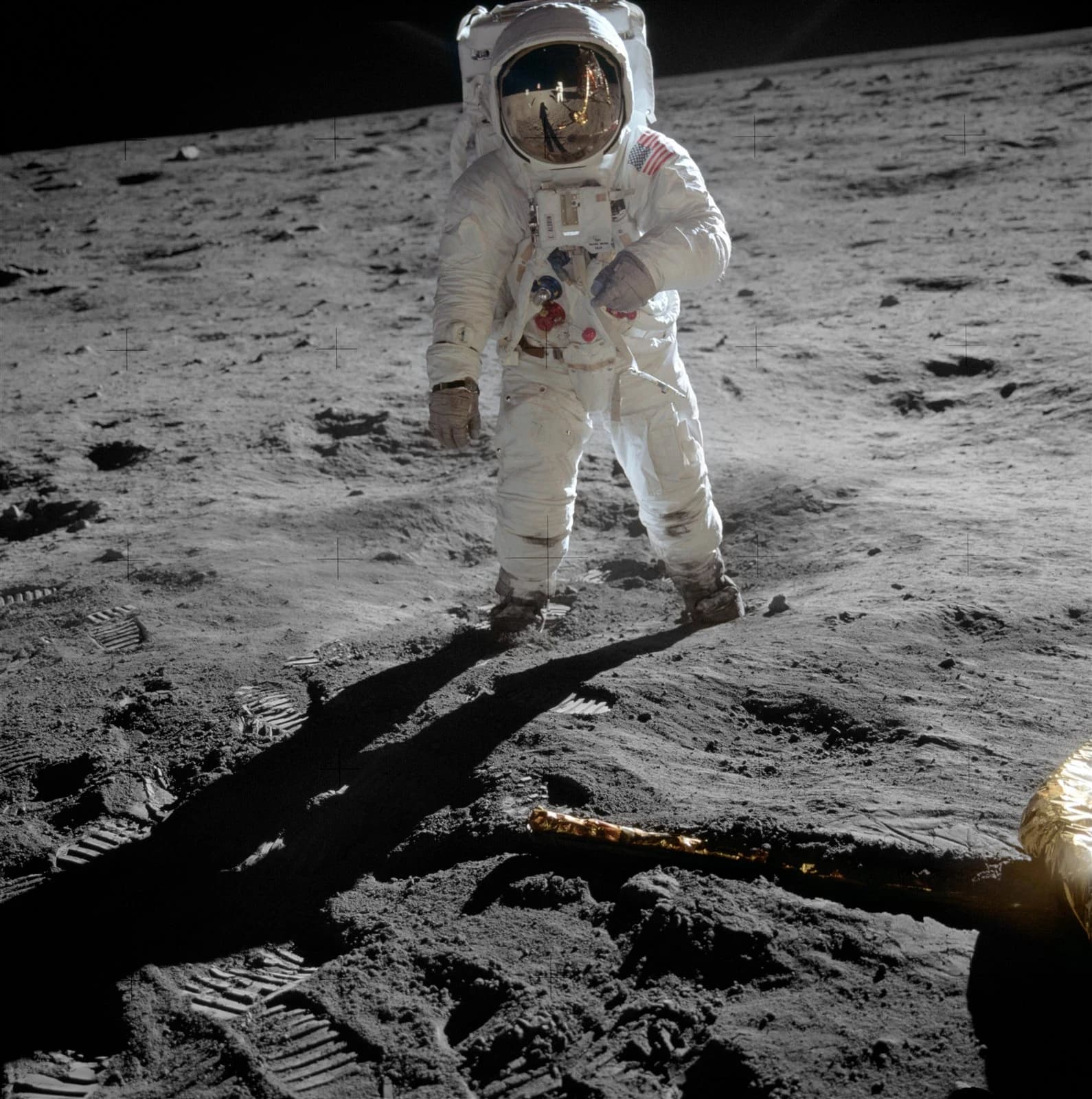
Armstrong and Aldrin collected rock and soil samples, photographed the site, and deployed experiments. Lunar material returned by Apollo missions helped establish the Moon’s ancient history and supported the giant-impact account of its origin. Reflectors left on the surface still allow laser ranging measurements from Earth.
Sample handling was itself a scientific system. Documentation, sealed containers, contamination control, curation, and later access let new generations apply instruments that did not exist in 1969.
The lesson is organizational as well as technical
Apollo joined political urgency, extraordinary funding, industrial capacity, risk, and the work of hundreds of thousands of people. Its success cannot be reduced to a heroic crew or a single machine. It shows what coordinated engineering can achieve and how much infrastructure is required to make a brief human action possible on another world.