
.jpg)
One adjective, two scientific problems
Dark matter and dark energy are often placed in the same sentence because neither has been identified in the laboratory. Their roles in cosmology are nevertheless very different. Dark matter behaves, at the scales astronomers measure, like additional gravitating material. Dark energy is the name given to whatever drives or describes the observed acceleration of cosmic expansion.
Neither term means that scientists have simply labelled ignorance and stopped investigating. Each name connects a large set of observations to models that make testable predictions. The open question is what underlying physics produces the measured behaviour.
Why astronomers infer dark matter
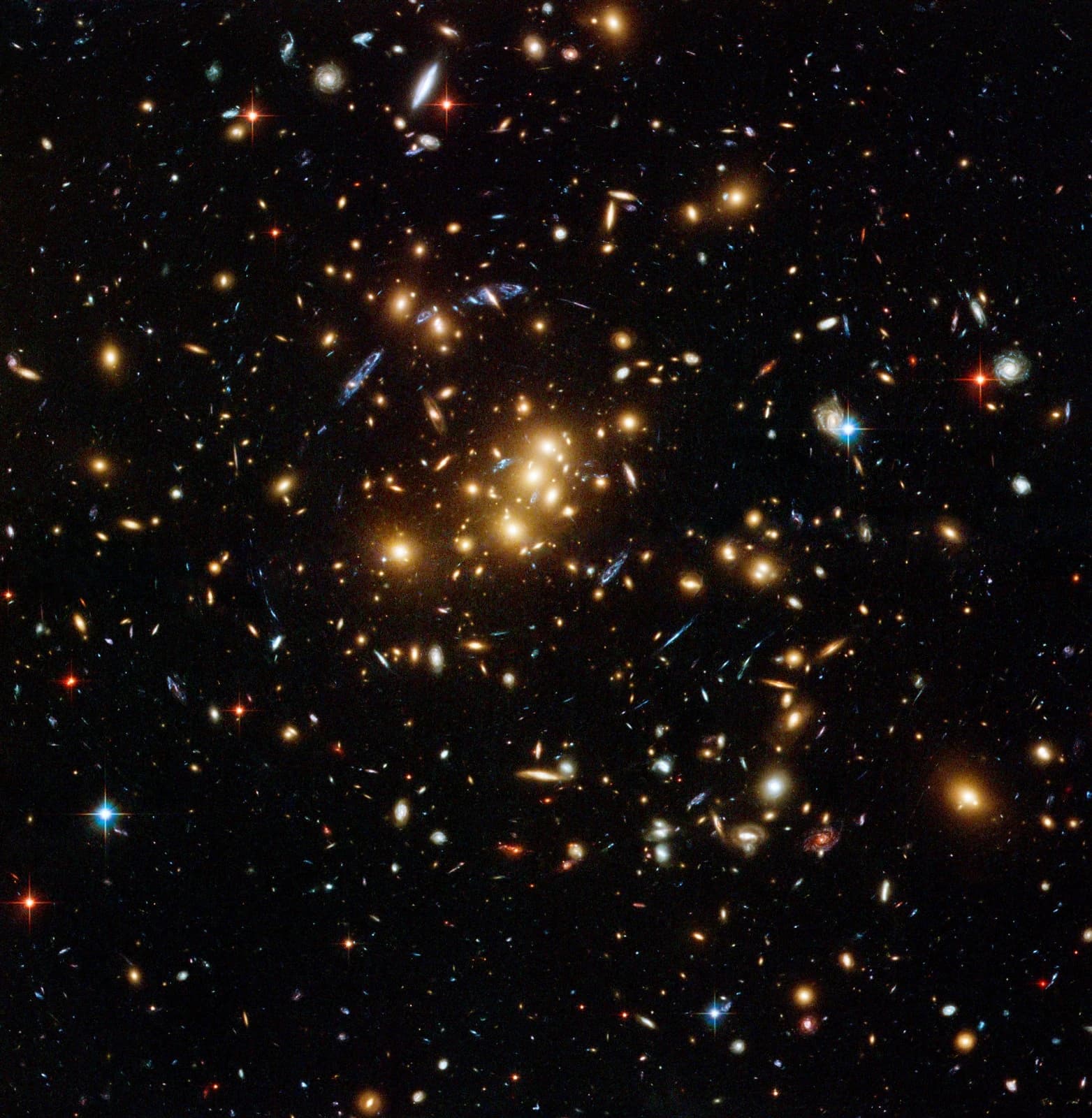
Galaxies and galaxy clusters move as though they contain more gravitating mass than their visible stars and gas provide. Gravitational lensing offers another line of evidence: mass bends the path of light, allowing researchers to map matter even when it emits little or no light. Measurements of the cosmic microwave background and the growth of large-scale structure also support a universe containing substantial non-luminous matter.
Ordinary faint objects cannot account for all of this effect. The leading models use a new kind of particle that interacts weakly with light, although no candidate has yet been confirmed. Direct-detection experiments search for rare interactions in shielded detectors, while accelerators and astronomical observations test complementary possibilities.
Modified theories of gravity are also studied. Any successful alternative must explain several kinds of evidence at once, not only the rotation speed of a single galaxy.
Why dark energy entered cosmology
In the late 1990s, observations of distant type Ia supernovae indicated that cosmic expansion has been speeding up rather than slowing under gravity alone. Other measurements, including the cosmic microwave background and galaxy clustering, fit a similar picture.
The simplest model represents dark energy with a cosmological constant: an energy density associated with empty space. That model fits much existing data, but its theoretical interpretation remains difficult. Researchers also test whether dark energy changes over time or whether general relativity needs modification on the largest scales.
Percentages are model-dependent measurements
You may read that ordinary matter makes up about five percent of the universe, dark matter about a quarter, and dark energy most of the remainder. These figures summarize the standard cosmological model fitted to multiple datasets. They are not a direct inventory made by placing the universe on a scale. Improved observations can narrow uncertainties or reveal tension between datasets.
ESA’s Euclid mission and other surveys map galaxies and gravitational lensing across large regions of the sky. Their goal is not to photograph dark energy. It is to measure how cosmic structure and expansion changed over time, then compare those patterns with competing models.