
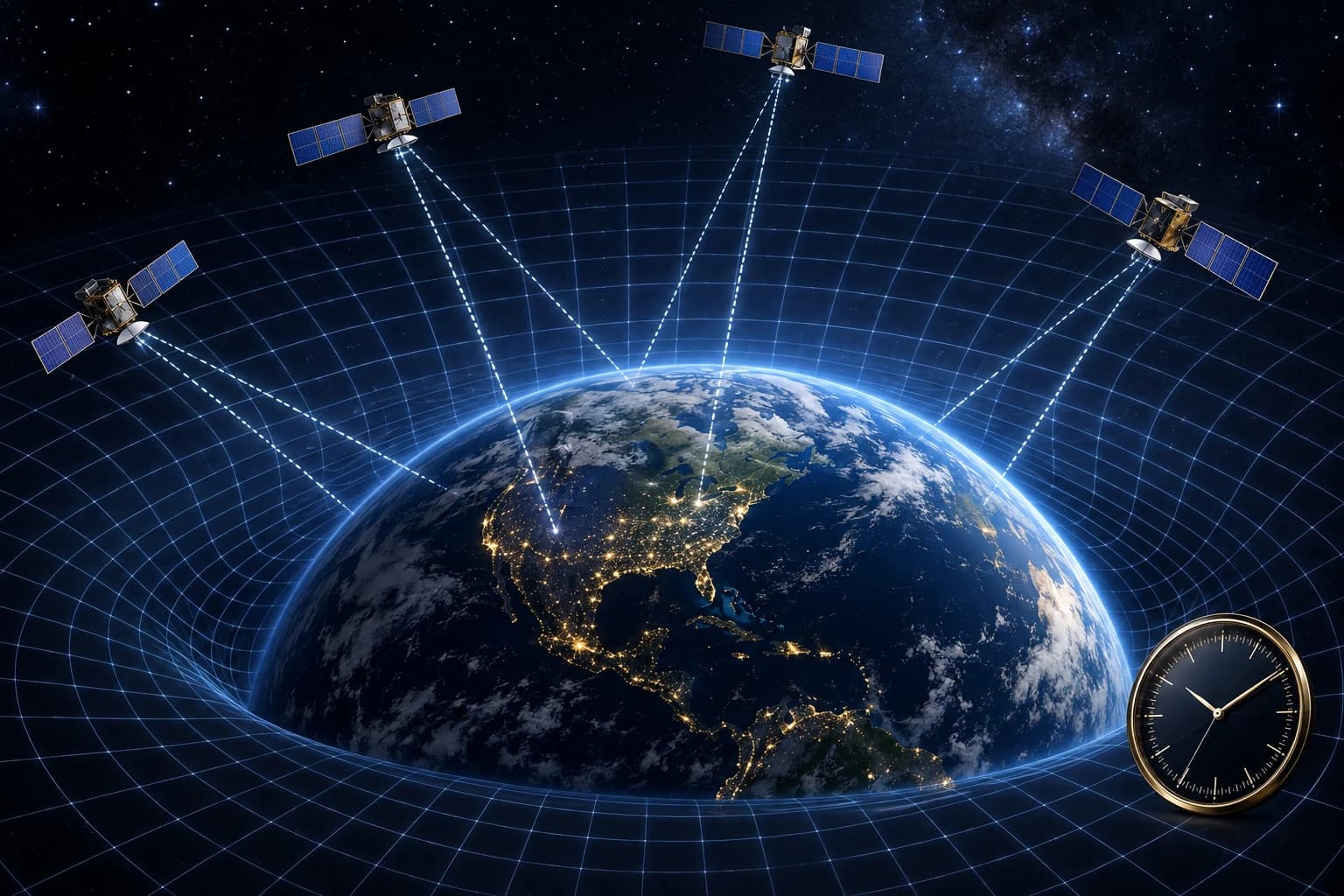
Gravity becomes geometry
Newtonian gravity remains an excellent approximation for many practical problems, but general relativity changes the underlying picture. Matter and energy influence the geometry of spacetime, and freely moving objects follow paths through that geometry. What appears as a gravitational pull can be described as motion in curved spacetime.
The equivalence principle provides an entry point. Inside a small sealed laboratory, the effects of uniform acceleration can resemble the effects of a gravitational field. Einstein developed this clue into a theory in which space, time, motion, and gravity could no longer be treated as separate ingredients.
The theory makes measurable predictions
General relativity explained a small unexplained shift in Mercury’s orbit and predicted that gravity bends light. Measurements during the 1919 solar eclipse helped make that prediction famous, although modern tests are far more precise. The theory also predicts gravitational redshift, time dilation near mass, black holes, and ripples in spacetime called gravitational waves.
These phenomena occur on very different scales but arise from the same framework. Astronomers observe stars orbiting compact objects, compare the paths of light through galaxy clusters, and detect gravitational waves from merging black holes and neutron stars. Precision laboratory clocks can measure gravitational time differences across surprisingly small changes in height.
Why satellite navigation needs relativity
GPS satellites carry atomic clocks and broadcast timing signals. A receiver estimates its position by comparing signal arrival times from multiple satellites. Small clock errors therefore become position errors.
Satellite clocks experience two important relativistic effects. Their orbital motion makes them run differently according to special relativity, while their position higher in Earth’s gravitational field changes their rate according to general relativity. The effects point in opposite directions and do not cancel. Navigation systems account for the net difference in their design and operation.
This does not mean a phone solves Einstein’s field equations every time a map opens. Relativistic corrections are built into the timing system, orbital models, and synchronization procedures that make the service reliable.
A successful theory can still be incomplete
General relativity has passed demanding tests, yet it does not provide a complete quantum description of gravity. Near singularities or at extremely small scales, researchers expect a deeper framework to be necessary. Dark matter and dark energy also raise questions about how gravity and cosmic contents should be understood.
Calling a theory “scientific” does not mean it is a guess. It means the framework connects explanations with predictions that can be compared against evidence. General relativity remains central because many independent measurements continue to support it within the domains tested.