
From interpretation to measurement
Early debates about quantum mechanics often sounded philosophical. Could particles possess definite properties that quantum theory simply failed to describe? Could distant measurements influence one another? John Bell showed that part of the disagreement had observable consequences.
Bell considered local hidden-variable models: explanations in which outcomes are influenced by pre-existing local information and no relevant influence travels faster than light. He derived inequalities that limit the correlations such models can produce. Quantum mechanics predicts stronger correlations for suitable measurements on entangled systems.
The basic experimental logic
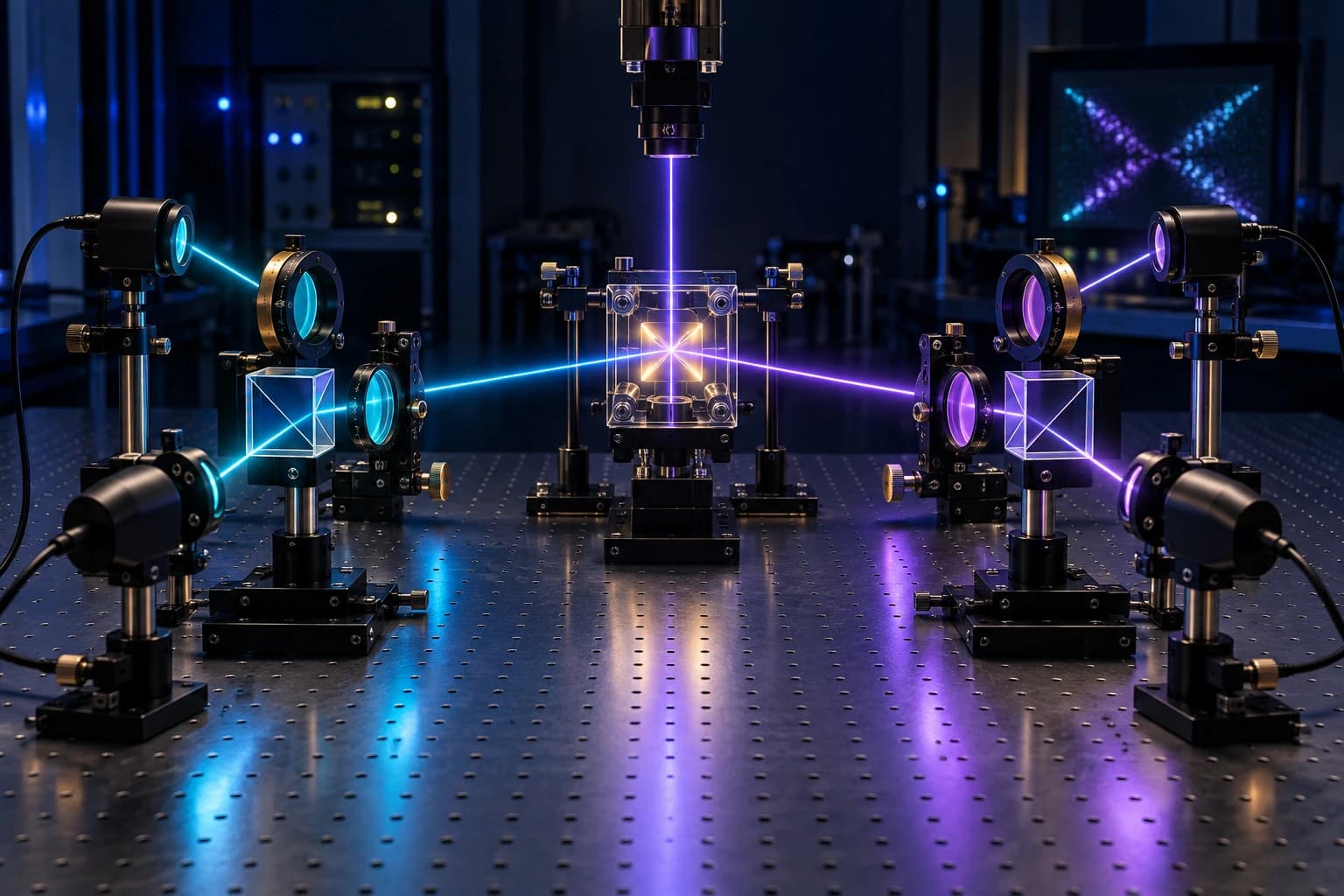
An experiment creates pairs of entangled particles and sends the members to separated measurement stations. Each station chooses between measurement settings and records an outcome. Researchers later compare many trials. If the observed correlations violate a Bell inequality, the tested class of local hidden-variable models cannot explain the data.
The separation and random setting choices matter. If one station could learn the other setting in time to alter its output, the experiment would not cleanly test locality. Efficient detection matters too. If too many events are missed, the detected subset might not represent all emitted pairs.
Loopholes drove better engineering
No real experiment is perfect. Early Bell tests faced detection, locality, and source-related loopholes. This did not make them useless; it gave experimentalists a map of what to improve. Better photon detectors, faster random setting choices, larger separation, and alternative physical systems progressively tightened the tests.
In 2015, several groups reported experiments designed to close major loopholes simultaneously. Results continued to agree with quantum predictions. The work recognized by the 2022 Nobel Prize in Physics also helped transform entanglement from a foundational puzzle into a tool for quantum information science.
What a violation does and does not mean
A Bell violation does not allow faster-than-light messaging. Local outcomes remain individually unpredictable, and the correlation is established after ordinary comparison. It also does not select one unique interpretation of quantum mechanics. Different interpretations can reproduce the same experimental statistics while disagreeing about what the mathematics means.
The achievement is more disciplined: a broad intuitive picture of nature cannot reproduce what experiments observe. Bell’s work demonstrates how science can turn assumptions that seem philosophical into quantities that instruments can test.