
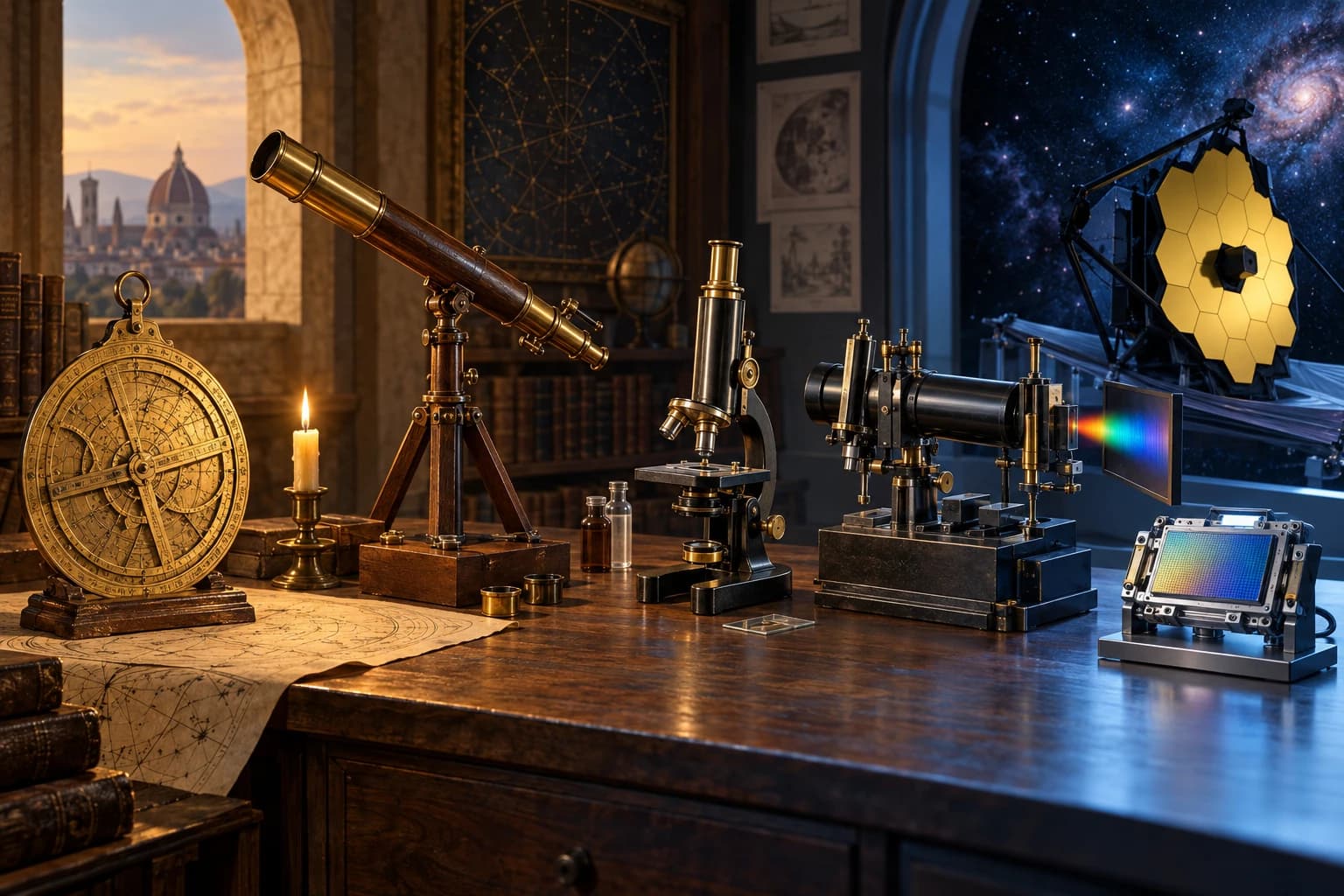
Evidence depends on what can be detected
Scientific change is often narrated as a triumph of new ideas, yet ideas are constrained by observation. An instrument can reveal an object that was previously invisible, turn a qualitative impression into a number, or preserve a signal for comparison by other researchers. Better instruments therefore change not only answers but the questions that can be asked.
This does not make instruments neutral windows. Every device has a range, calibration, resolution, and source of error. Scientists must learn what a measurement means before using it to support a theory.
Telescopes expanded the sky
Early seventeenth-century telescopes revealed mountains on the Moon, moons orbiting Jupiter, and phases of Venus. These observations challenged the idea that every celestial body must orbit Earth and that the heavens were perfectly smooth. The telescope did not settle cosmology in a single night; it supplied evidence that older systems had difficulty accommodating.
Larger mirrors, spectroscopy, photography, electronic detectors, adaptive optics, and space observatories later turned astronomy into a multi-wavelength science. The sky looks different in radio, infrared, visible, ultraviolet, X-ray, and gamma-ray light because different physical processes dominate each region.
Microscopes created a populated hidden world
Microscopes made fine biological structures observable and supported the development of cell theory. Their history also shows the importance of preparation and interpretation. Lenses can introduce distortion; staining can alter samples; and seeing a structure does not automatically explain its function.
Modern microscopy includes electron beams, fluorescence markers, scanning probes, and computational reconstruction. Each method trades among resolution, sample conditions, speed, and the kind of information measured.
Clocks and standards made comparison possible
Precision clocks transformed navigation, astronomy, engineering, and tests of fundamental physics. Standard units and reference materials let measurements made in different laboratories become comparable. A number without a traceable method and uncertainty is less useful than it appears.
Today, software and statistical pipelines are part of the instrument. A telescope survey or genome sequencer can produce more raw data than people could inspect manually. Algorithms calibrate signals, remove known artefacts, and identify candidates. This increases reach while creating a new obligation: code, assumptions, and validation must be documented like physical apparatus.
Instruments and theories develop together
Theory guides what an instrument is built to detect, while unexpected signals can force theory to change. The relationship is circular in a productive way. Science advances when instruments, models, and independent checks constrain one another.