
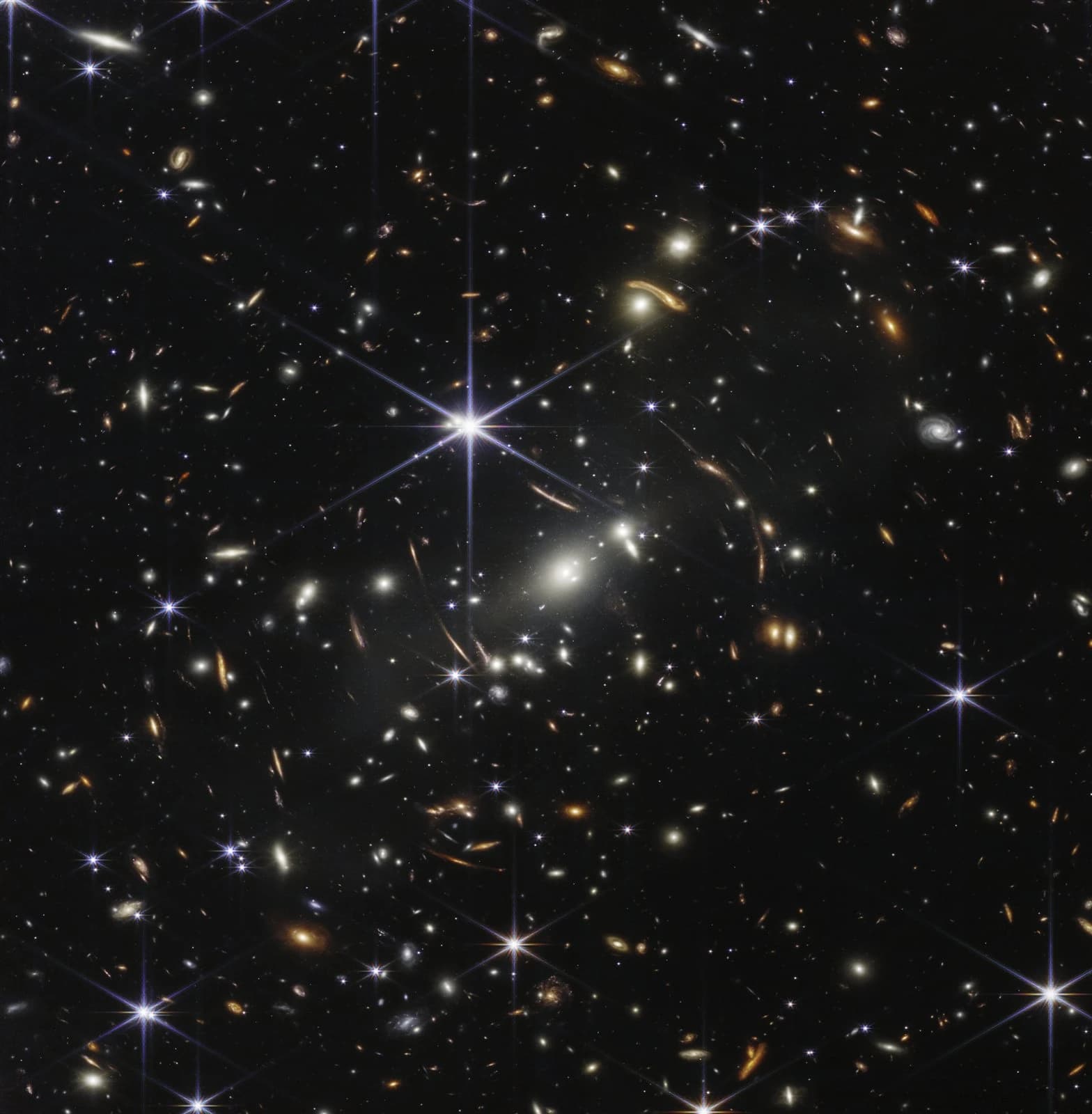

A telescope designed around ancient light
The James Webb Space Telescope was built around a demanding observation problem: much of the light from the first generations of stars and galaxies no longer reaches us at the wavelengths in which it began. As the universe expands, that light is stretched toward the infrared. Webb therefore observes primarily in near- and mid-infrared wavelengths, allowing it to detect signals that visible-light telescopes may miss.
Its primary mirror is made from eighteen hexagonal beryllium segments that work together as one 6.5-metre collecting surface. The larger surface gathers more light, while precise actuators align the segments after launch. This engineering does not create sharper pictures by magic; it gives the instruments enough sensitivity and angular resolution to separate faint structures from a dark background.
Why Webb lives far from Earth
Webb operates near the Sun-Earth L2 region, roughly 1.5 million kilometres from Earth. From that location, Earth and the Sun remain on the same side of the observatory. A five-layer sunshield can continuously block their heat and light while the telescope faces outward. The shield is essential because warm objects emit infrared radiation. If Webb were warm, its own glow would interfere with the weak cosmic signals it was designed to measure.
The observatory does not sit motionless at one point. It follows a controlled orbit around L2 and requires periodic adjustments. That arrangement simplifies thermal control but also means Webb was designed for remote operation rather than astronaut servicing.
What an infrared spectrum reveals
Webb produces images, but spectroscopy is equally important. A spectrum separates incoming light by wavelength. Patterns of absorption and emission can reveal which atoms and molecules are present, while shifts in those patterns can show motion or cosmic expansion. Astronomers use these measurements to estimate galaxy distances, study star formation hidden by dust, and investigate the atmospheres of some exoplanets.
An exoplanet spectrum is not a photograph of weather or life. Researchers compare the small change in starlight during a transit with models of how different molecules interact with light. Clouds, instrument noise, stellar activity, and overlapping molecular signatures can complicate the result. Strong claims require repeated observations and independent analysis.
Webb looks back in time, not outside time
Light takes time to travel. Observing a galaxy billions of light-years away means receiving light that left it billions of years ago. Webb therefore samples earlier chapters of cosmic history. It does not see the Big Bang itself, and a colourful processed image is not a literal view through human eyes. Scientific images combine calibrated measurements, filters, and colour assignments so that otherwise invisible infrared structure can be interpreted.
Webb is most valuable as part of a wider system. Its observations are combined with data from Hubble, Chandra, ground-based observatories, and future missions. Different instruments cover different wavelengths and scales, helping researchers test whether an apparent discovery survives comparison.