
A material between conductor and insulator
In a metal, many electrons can move through the material. In an insulator, available electronic states make current much harder to sustain. A semiconductor occupies a useful middle ground. Its electrical behaviour can be changed through temperature, light, electric fields, and small amounts of added atoms called dopants.
Silicon dominates much of modern electronics because it is abundant, forms a stable oxide, and can be manufactured with extraordinary control. Its usefulness is not simply that it “sometimes conducts.” Engineers create regions with different charge-carrier behaviour and arrange junctions that respond predictably to voltage.
The transistor is a controllable switch
A field-effect transistor uses an electric field at a gate to influence current through a channel. A small change at the gate can represent or control a binary state. Logic gates combine transistors to perform operations, while memory cells preserve information in physical states.
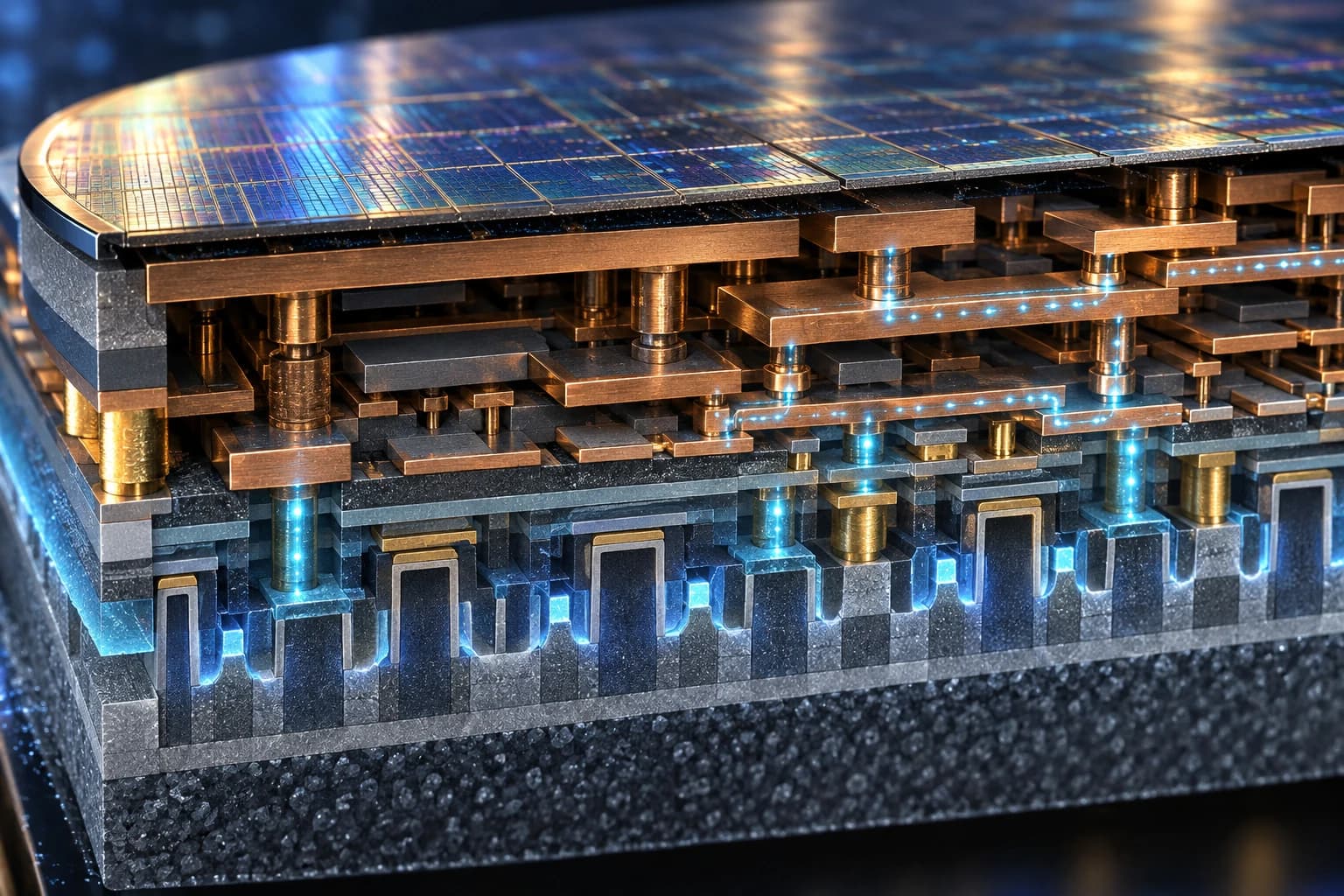
One transistor does little. Integrated circuits become powerful by patterning enormous numbers of transistors and their connections onto layers of a chip. Manufacturing requires photolithography, deposition, etching, implantation, polishing, inspection, and repeated measurement. At advanced scales, a small variation in a layer or feature can change performance across an entire device.
Smaller features create opportunities and problems
Shrinking components historically improved speed, cost, and energy efficiency, but dimensions alone do not tell the whole story. Leakage current, heat, interconnect delay, quantum tunnelling, manufacturing variability, and rising fabrication cost force engineers to change materials and transistor geometry.
Modern processors use techniques such as three-dimensional transistor structures, specialized accelerators, chiplets, and advanced packaging. Performance gains increasingly come from system design as well as from smaller features.
Measurement is part of manufacturing
Chip production depends on metrology: the science of measurement. Manufacturers need reference methods for dimensions, material composition, electrical behaviour, contamination, and defects. Standards allow instruments and factories to compare results. Without reliable measurement, a process cannot be controlled closely enough for high yields.
Supply chains also matter. A finished chip may depend on design software, ultrapure materials, precision optics, specialized equipment, fabrication plants, packaging, and testing across several countries. Calling a chip a single invention hides this accumulated infrastructure.
Quantum physics is necessary, not mysterious decoration
Semiconductor behaviour depends on quantum mechanics, including energy bands and tunnelling. That does not make an ordinary processor a quantum computer. Conventional chips encode information in robust electrical states involving many particles. Quantum computers deliberately preserve and manipulate fragile quantum states for different kinds of computation.