
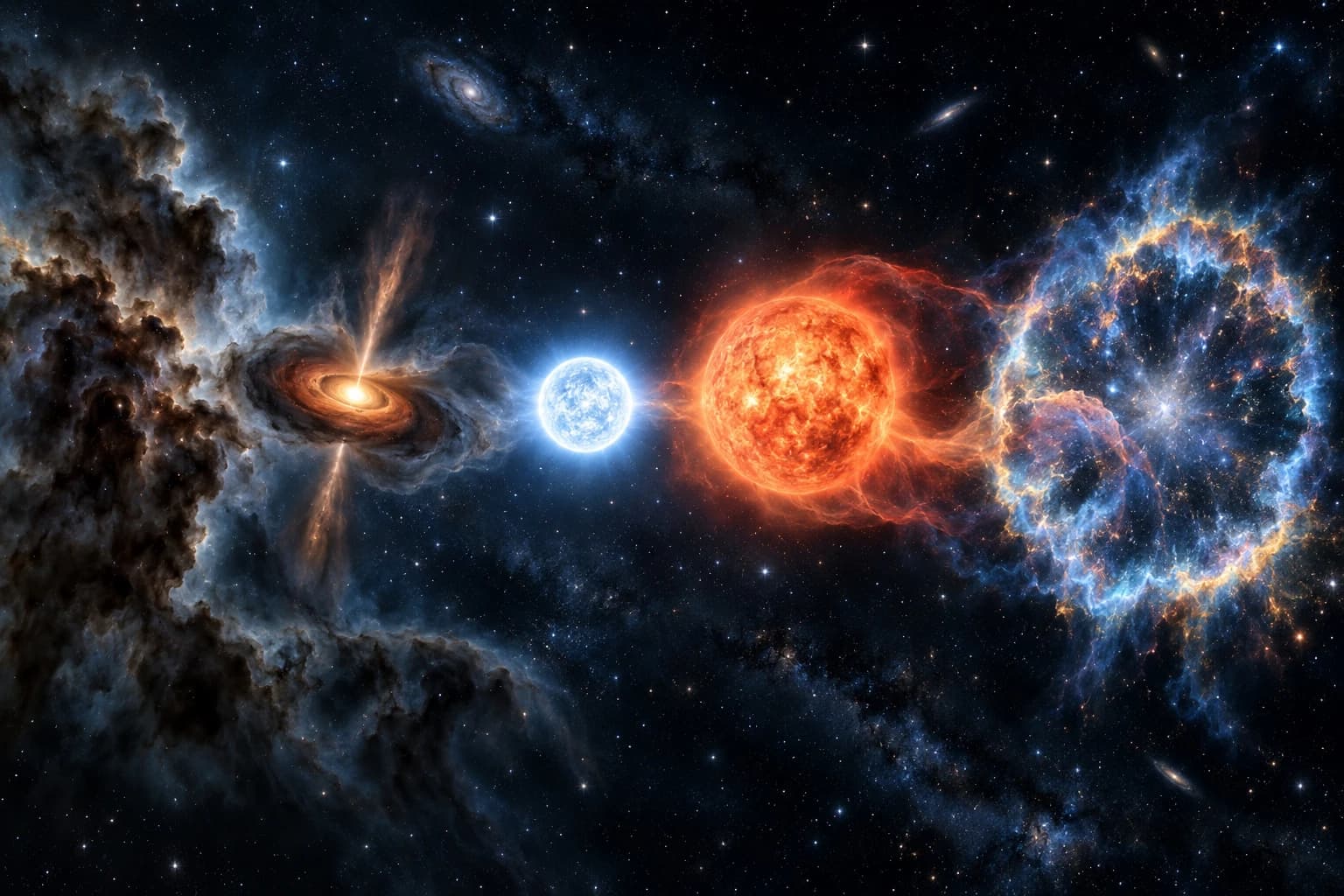
Gravity begins the story
Stars form inside regions of gas and dust where gravity can pull material into denser clumps. A collapsing clump does not fall straight into a finished star. It fragments, rotates, heats up, and often forms a disk. As material continues to collect, the centre becomes a protostar. The object enters its long stable phase only when conditions in the core allow sustained hydrogen fusion.
Fusion joins light nuclei and releases energy. That energy moves outward and helps support the star against further gravitational collapse. A main-sequence star is therefore a dynamic balance: gravity pulls inward while pressure associated with hot material and radiation pushes outward. The balance can last millions to trillions of years, depending mostly on mass.
Mass changes the timetable
Massive stars contain more fuel, but they consume it much faster because their cores are hotter and denser. Small red dwarfs use fuel slowly. A star like the Sun occupies the middle ground. This is why a more massive star can have a much shorter life even though it began with more hydrogen.
When core hydrogen becomes scarce, the internal balance changes. The core contracts and heats while outer layers expand. Sun-like stars become red giants and can fuse helium into heavier elements such as carbon and oxygen. They later release their outer layers, leaving behind a dense white dwarf. The glowing gas around it is temporary; the remnant cools over an immense span of time.
Massive stars build and scatter heavy elements
Very massive stars can continue through additional fusion stages, producing successively heavier nuclei. Fusion up to iron does not provide an endless energy source. Once the core can no longer support itself, it may collapse in seconds. The collapse and rebound can drive a supernova, while the compressed core becomes a neutron star or, if sufficiently massive, a black hole.
Not every massive star follows exactly the same route. Rotation, magnetic fields, chemical composition, binary companions, and mass loss can alter the outcome. Modern stellar evolution is a family of models tested against clusters, spectra, gravitational waves, neutrinos, and the remnants left after explosions.
We are made from recycled stellar material
The early universe was dominated by hydrogen and helium. Stars and stellar explosions changed the chemical inventory of galaxies. Carbon, oxygen, silicon, iron, and many other elements were forged or dispersed through stellar processes. Merging neutron stars also contribute to some of the heaviest elements. Later generations of stars and planets formed from this enriched material.
This does not mean every atom in a person passed through a supernova. Different elements have different histories. The accurate idea is broader: the material available to build rocky planets and living chemistry was transformed by earlier generations of stars.