
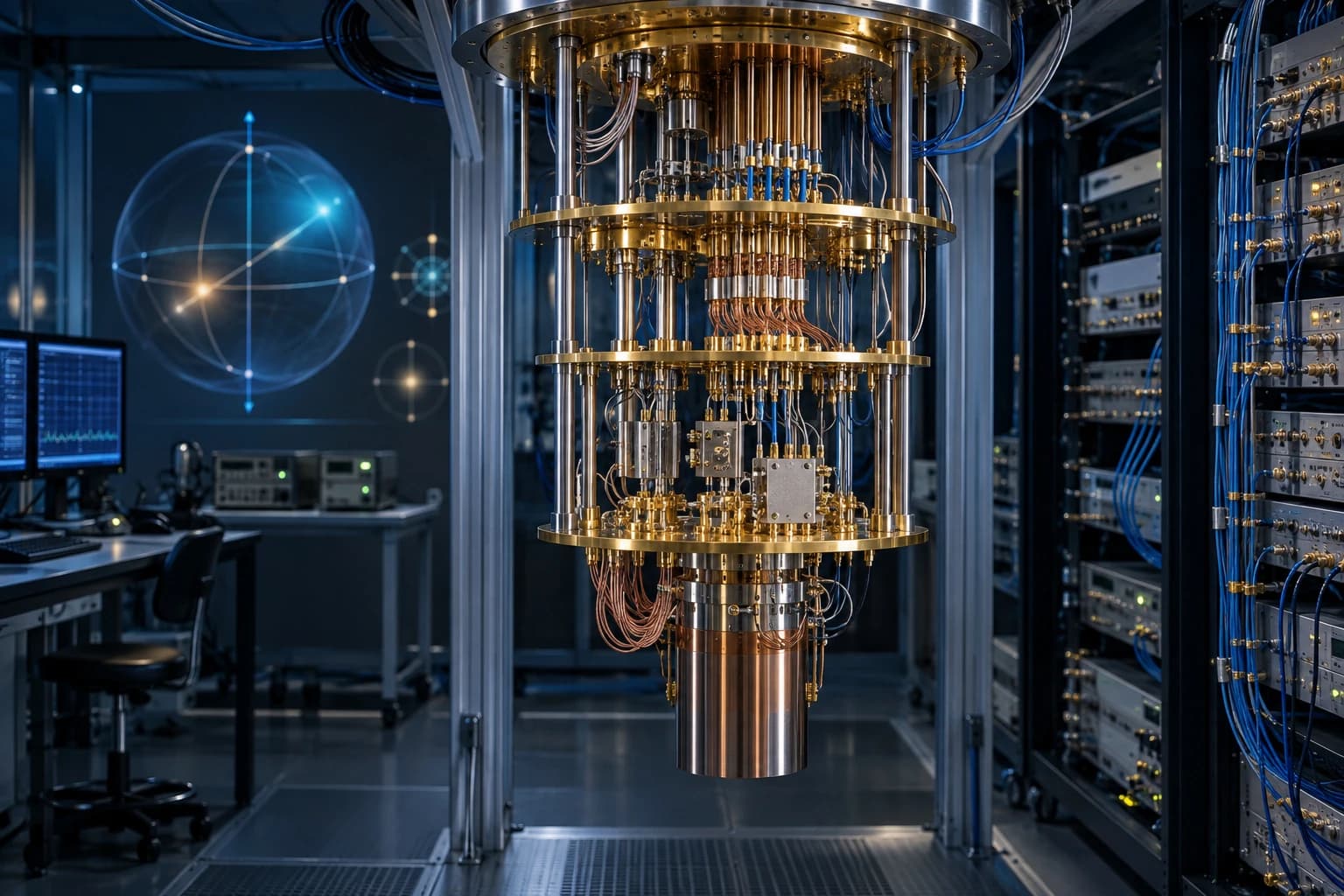
A qubit is not simply a faster bit
A classical bit is represented by one of two robust states. A qubit can be prepared in a quantum state whose measurement has two possible outcomes, and multiple qubits can be entangled. Quantum algorithms control amplitudes so that useful outcomes become more likely while others interfere destructively.
This does not mean a quantum computer evaluates every answer and reads them all at once. Measurement returns limited classical information. An algorithm must be designed so that interference encodes a useful property into the probabilities that can be sampled.
Advantage depends on the problem
Some quantum algorithms offer major theoretical improvements. Shor’s algorithm can factor large integers efficiently on a sufficiently capable fault-tolerant quantum computer, threatening widely used public-key systems. Grover’s algorithm gives a more modest square-root improvement for unstructured search. Quantum simulation may help study molecules and materials whose states are difficult to represent classically.
These examples do not imply that web browsing, spreadsheets, or ordinary machine learning will automatically run faster. Classical hardware and algorithms continue to improve, and a claimed quantum advantage must include realistic data loading, error rates, runtime, and the best known classical comparison.
Noise is the central engineering challenge
Qubits interact with their environment and lose coherence. Control operations and measurements are imperfect. Simply copying a quantum state for backup is not allowed in the general case, so error correction uses entanglement and carefully designed measurements to detect errors without directly reading the encoded information.
A logical qubit protected by error correction may require many physical qubits. The exact overhead depends on hardware quality, code design, connectivity, and the algorithm. This gap between physical and logical qubits is why counting devices by qubit number alone gives an incomplete picture.
Different hardware platforms make different trades
Superconducting circuits, trapped ions, neutral atoms, photons, semiconductor spins, and other systems are being developed. They differ in operating temperature, gate speed, coherence, connectivity, fabrication, and readout. No platform has yet won every category.
Cloud access lets researchers test small devices and develop software, but present machines remain limited. Hybrid methods combine classical optimization with quantum circuits, though evidence of practical advantage must be evaluated case by case.
Prepare for progress without predicting a date
Governments and organizations are already moving toward post-quantum cryptography because encrypted information can remain sensitive for years. That is a rational response to future risk, not proof that a cryptographically relevant quantum computer exists today.
The responsible outlook is neither dismissal nor certainty. Quantum information has produced real experiments, devices, and algorithms. Scaling them into reliable, economically useful computers is an open engineering program whose milestones should be judged by reproducible performance.