
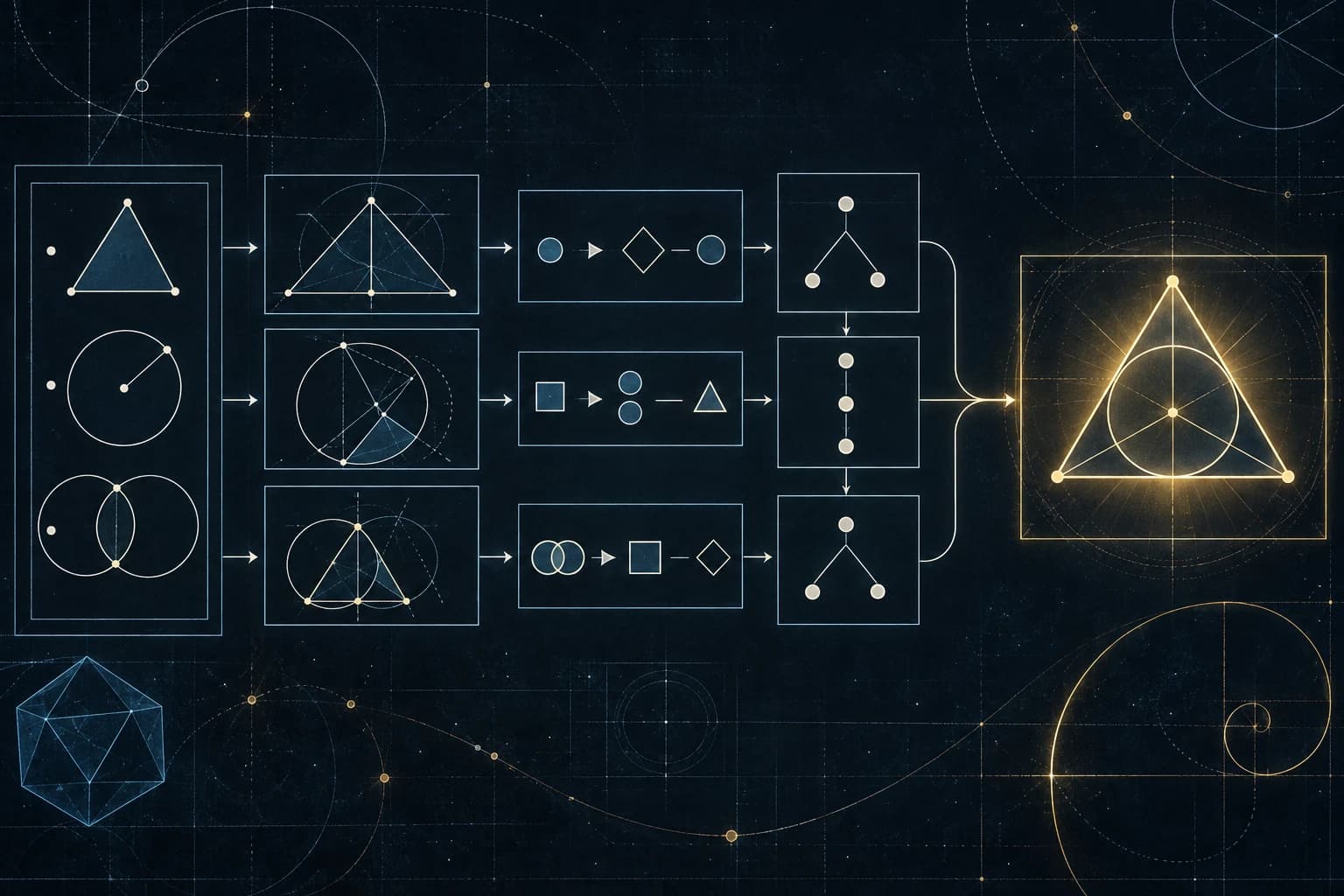
Evidence and proof answer different questions
Calculating a thousand examples can provide strong evidence for a pattern, but it does not usually establish that the pattern continues forever. A mathematical proof starts from stated definitions and assumptions, then uses accepted rules of reasoning to show that a conclusion is unavoidable.
This standard makes mathematical knowledge unusually durable. Once a valid proof is understood, later computers can check more examples without changing why the theorem is true. At the same time, proofs are human arguments: they must communicate enough structure for knowledgeable readers to verify each step.
Several proof strategies solve different problems
A direct proof moves from assumptions to a conclusion through a chain of implications. A proof by contradiction assumes the opposite of the desired result and derives an impossibility. Mathematical induction establishes a base case and shows that each case leads to the next. Constructive proofs demonstrate existence by building an object, while non-constructive proofs may show that something must exist without providing an explicit example.
These are not ceremonial formats. Choosing a strategy exposes the structure of a problem. An induction proof suggests a recursive relationship. A contradiction may reveal that several plausible conditions cannot coexist.
Definitions carry much of the reasoning
Many disagreements disappear when definitions are made precise. “Continuous,” “random,” “equal,” and “infinite” have technical meanings that may differ from everyday use. A theorem is only as clear as the objects and conditions it addresses.
Euclid’s Elements became influential not because every proposition was new, but because it organized geometry around definitions, postulates, and deductions. Modern mathematics uses more formal foundations and recognizes that axiom systems can produce different valid geometries and structures.
Computers extend proof without replacing understanding
Computer algebra can manipulate expressions, and numerical software can test enormous cases. Proof assistants go further by checking formal logical steps against a small trusted core. Computer-assisted proofs are valuable for arguments with calculations or case analyses too large for unaided checking.
Formal verification also exposes a trade-off. Translating an ordinary proof into machine-checkable detail takes substantial work. A verified script may guarantee logical correctness while offering less intuitive explanation. The strongest practice combines reliability with ideas that humans can reuse.
Uncertainty still enters applied mathematics
A theorem can be exact while its application depends on an approximate model. Weather forecasts, epidemiological models, and engineering simulations combine mathematics with measurements, assumptions, and estimated parameters. Proving a property of the model does not automatically prove that the model captures every relevant feature of the world.
Mathematical literacy therefore includes two habits: demanding valid reasoning inside the mathematics and questioning how abstract assumptions connect to evidence outside it.